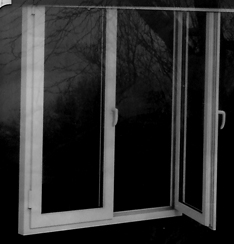
A window's thermal performance is expressed as its Uw value — the overall thermal transmittance in W/(m²K), which combines the glass unit (Ug) and the frame (Uf). A standard double-glazed window from the 1990s typically has a Uw of around 2.5–3.0 W/(m²K). Current Polish regulations under WT 2021 set the maximum permissible Uw at 0.9 W/(m²K) for new construction from 2021 onwards. Renovation work targeting subsidies under Czyste Powietrze generally requires Uw ≤ 0.9 W/(m²K) at minimum, with higher subsidy tiers requiring Uw ≤ 0.5–0.6 W/(m²K).
Double versus triple glazing
Double glazing (two glass panes, one gas-filled cavity) with low-emissivity (low-e) coating and argon fill reaches Ug values of 1.0–1.2 W/(m²K). Triple glazing (three panes, two cavities) with krypton or argon fill and two low-e coatings achieves Ug values of 0.5–0.7 W/(m²K). The difference in frame performance then determines the final Uw.
| Configuration | Typical Ug W/(m²K) | Typical Uw (with good frame) | Relative cost |
|---|---|---|---|
| Double, argon, low-e | 1.0–1.2 | 1.1–1.4 | Base |
| Triple, argon, 2× low-e | 0.6–0.7 | 0.8–1.0 | +20–35% |
| Triple, krypton, 2× low-e | 0.5–0.6 | 0.7–0.9 | +40–60% |
| Triple, vacuum insulated glass | 0.3–0.4 | 0.5–0.7 | +100–150% |
For most renovation projects in Poland, triple glazing with argon fill and good PVC or timber frames delivers the combination of performance and cost that aligns with Czyste Powietrze eligibility. Krypton-filled units narrow the gap further but at a cost premium that rarely pays back in energy savings within a standard investment horizon.
Frame materials compared
The frame accounts for roughly 20–30% of a window's area and can significantly pull up the final Uw even when the glass unit is excellent.
PVC frames
PVC (uPVC) frames are the most common choice in Polish renovation projects. Modern five- or six-chamber profiles achieve Uf values of 1.0–1.3 W/(m²K). High-performance profiles with foam inserts reach Uf of 0.7–0.9 W/(m²K). PVC requires minimal maintenance, is resistant to moisture, and is available from a wide range of Polish manufacturers at competitive prices.
Timber frames
Solid wood or engineered timber frames perform well thermally, with Uf values of 1.0–1.4 W/(m²K) for standard profiles and down to 0.7 W/(m²K) for high-performance timber composites. They require regular surface treatment (painting or staining every 5–10 years) and are susceptible to moisture damage if maintenance is neglected. Preferred for heritage buildings and for homeowners who prefer natural materials.
Aluminium frames
Standard aluminium profiles without thermal break are unsuitable for energy-efficient windows — Uf can exceed 5.0 W/(m²K). Modern aluminium with thermal break reaches Uf of 1.5–2.5 W/(m²K). High-performance "passive" aluminium profiles reach 0.8–1.0 W/(m²K). The material is durable and suits large-format glazing, but cost is higher than PVC for equivalent thermal performance.
Gas fill degradation: Argon and krypton fills in insulating glass units gradually leak through edge seals. Most manufacturers quote a fill retention of over 90% after 25 years, but at elevated levels of leakage — from damaged seals or poor installation — thermal performance can drop noticeably. Checking the perimeter seal condition on existing units is worthwhile before deciding to repair rather than replace.
Solar heat gain: the g-value
The g-value (solar factor) describes how much solar energy passes through the window. South-facing windows with a high g-value (0.5–0.6) contribute passive solar gain during Polish winters, partially offsetting heating demand. Applying solar-control low-e coatings reduces g to 0.3–0.4, which benefits south- and west-facing windows in summer but reduces the passive solar benefit in winter.
For south-facing windows in Poland, a g-value above 0.5 is generally preferable in combination with external shading (shutters or overhangs) to manage summer overheating. North-facing windows benefit from the lowest possible Uw and g-value is a secondary concern.
Installation quality and the PSI value
A well-specified window installed poorly will underperform. The linear thermal transmittance at the frame-to-wall junction (Ψ — psi value) is determined by how the window is positioned in the wall and how the reveal is insulated. Mounting the window flush with the outer insulation layer — or at least into the outer third of the wall — minimises the reveal thermal bridge. Reveals should be insulated with a minimum of 3–4 cm of EPS or equivalent to achieve acceptable psi values of under 0.05 W/(mK).
WT 2021 requirements in brief
Under Polish regulations, the following maximum Uw values apply from 2021:
- Roof windows: Uw ≤ 1.1 W/(m²K)
- External windows (side walls): Uw ≤ 0.9 W/(m²K)
- External doors: Uw ≤ 1.3 W/(m²K)
For energy class A buildings (NF40 standard), stricter targets of Uw ≤ 0.8 W/(m²K) for windows are common in design specifications. These reference values are taken from the official technical conditions published by the Polish Ministry of Infrastructure.
Replacing windows under Czyste Powietrze
Window replacement qualifies as an eligible cost under Czyste Powietrze when the new windows achieve at least Uw ≤ 0.9 W/(m²K). The programme covers windows up to an eligible unit cost of PLN 700/m² for subsidy calculation. Invoices, product certificates (CE marking, Uw confirmation from accredited laboratory), and an energy audit or building energy performance certificate are typically required for the application.